
Playgrounds & Sandpiles
Bak's Sandpile as warning—and possible compass

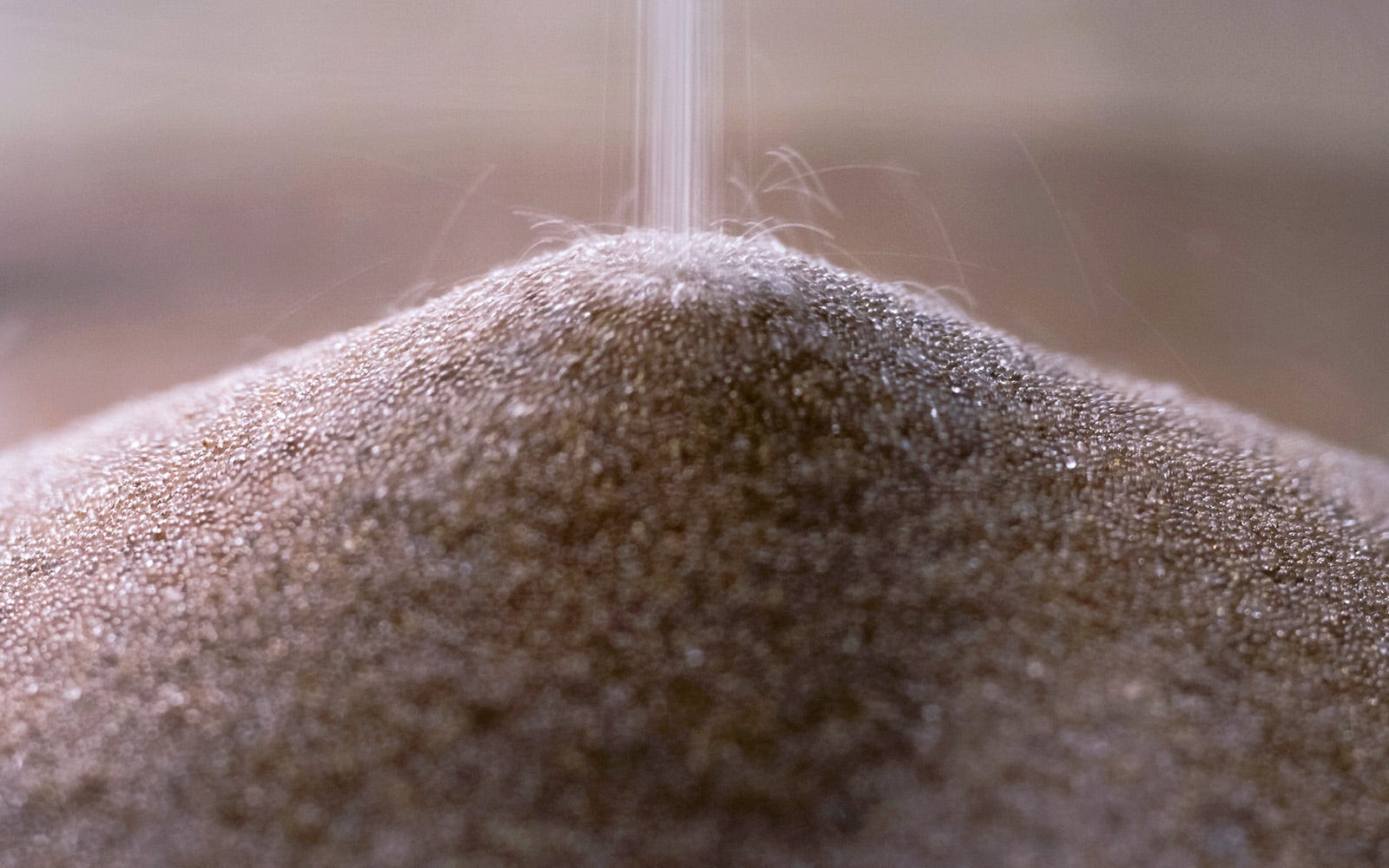
Andy’s note: this is an excerpt from a conversation with ChatGPT 5.5 Pro, lightly edited. We are exploring themes of using “gentle motion” to foster self-corrigibility/reboot life’s learning loop, but wanting to bias toward preserving try-again capacity. I am being lazy here and pasting in Pro’s output rather than writing a prefacing essay (for now).
Bak’s Sandpile provides a dramatic—but still useful—warning. The geometric claim is:
A system is more likely in a tolerant-fluid regime when lower-order variance is visibly transformed into retained structures that open new degrees of freedom. A system is more likely in a Bak/criticality regime when visible motion does not generate new regulatory variety or future option-space.
GPT 5.5 Pro (6/30/26):
Bak’s sandpile does not just “look gentle.” It is built from gentle inputs. Grains arrive one by one; small local topplings occur; the pile appears to rebalance itself. But the Bak–Tang–Wiesenfeld model shows the pile can self-organize into a critical state in which avalanches occur at all scales, up to the size of the whole system.
So:
Gentle input is not safety
Gentle local release is not safety
Visible motion is not safety
But Bak’s pile also helps reveal the missing variable. The sandpile has motion and even emergent statistical structure. It can produce scale-free avalanche patterns. But in the ARM sense, it does not seem to produce new playable dimensions. It does not invent a game. It does not learn a new regulatory strategy. It does not turn sluffing into richer future movability.
That distinction is extremely useful.
Holling hands us the contrast
Holling/Gunderson adaptive-cycle language distinguishes conservation, release, reorganization, and renewal; in the reorganization phase, low connectedness and high resilience make novel recombination and experimentation possible. Many experiments fail, but some survive and become the seed of renewal.
Holling and Gunderson explicitly compare adaptive cycles to Bak-like sandpiles, then draw almost exactly the distinction we need. They say sandpiles may look similar at the level of collapse/reorganization, but living systems transform and invent new forms, while sandpiles do not evolve into new forms.
Bak’s pile: motion reorganizes slope-criticality.
Living/play systems: motion can reorganize the space of future possibilities.
That maps almost perfectly onto current ARM language: healthy structure “relocates variance upward,” while embrittled structure “suppresses variance everywhere”; the Variance Ladder asks not only whether variation is occurring, but whether authored variations open further authored variations, whether structures emerge, and whether those structures open higher-order variability.
Cybernetics: higher-order variance = growing regulatory variety
Ashby’s Law of Requisite Variety gives this a cybernetic backbone: a regulator must have enough variety to absorb or counter the variety arriving from the environment. Put simply, only variety can destroy variety; a system with too little internal variety cannot regulate a sufficiently varied disturbance stream. (panarchy.org)
In that language:
Bak’s pile does not appear to increase its regulatory variety. It has a simple threshold rule: local toppling. That rule produces complex aggregate behavior, but the system does not develop richer ways of responding.
Kids at play visibly increase regulatory variety. They learn turn-taking, dodging, joking, role switching, conflict repair, new rules, rules-about-rules, symbolic transformation, and bodily skill. The play system becomes better able to absorb disturbance without collapse.
So the cybernetic claim becomes:
Visible higher-order variance is evidence that the system is increasing its regulatory repertoire, not merely dissipating load.
This is a major upgrade over “gentle motion.”
Kauffman: higher-order variance = expansion of the adjacent possible
Kauffman’s adjacent possible gives us another strong match. Complex living systems do not merely vary within a fixed option-set; they expand into nearby possibilities, and by doing so increase the diversity of what can happen next. (Edge)
That is almost ARM’s current agency language: a move opens a board, a new axis appears, a structure forms that makes richer play possible. The current Core Concepts language says agency is not merely more variance; it is variance “made newly dimensional,” where a new axis, previously invisible lever, or richer structure becomes available.
So:
Bak: motion within an existing rule-space.
Kids-at-play: motion that expands the rule-space.
Bateson: play generates meta-variance
Bateson’s “deutero-learning” or “learning to learn” is also relevant. It points to changes in how experience gets punctuated into contexts and context markers — not merely different actions, but different ways of organizing what kind of situation one is in. (lchc.ucsd.edu)
That matters because kids at play do this constantly. A stick becomes a sword, then a wand, then a boundary marker. “You’re the dragon” becomes “no, now dragons can fly” becomes “base is safe” becomes “unless the dragon touches the tree first.” The system is not just producing moves; it is producing rules for producing moves.
That is higher-order variance in a very concrete sense.
Bak’s pile has no “rules-about-rules.” It has no context-switching. It has no “let’s pretend the hill is lava.” It does not reframe its own topplings.
Higher-order variance appears when the system begins varying how it varies.
ARM already has a version of this: “Capability is stabilized lower-order variance that expands the agent’s future variance-space,” and “a capability is retained structure, but retained structure is only agentic if it opens a new playground.”
Taleb: higher-order variance is visible optionality — but only if downside is bounded
Taleb’s contribution is the caution against cheerful emergence-talk. Trial and error is not automatically good. Taleb’s antifragility argument depends on exposure asymmetry: errors must be small or harmless relative to the upside, and optionality lets the system keep gains while discarding failed trials. (Edge)
That is almost too ARM-perfect.
Kids-at-play can be convex-ish when:
errors are small,
failed moves are cheap,
successful moves are retained,
new options open,
the child/system is not spent by the experiment.
Bak’s sandpile is not convex for the pile in any agentic sense. It may absorb small grains for a while, but avalanche size has a fat-tailed structure. The downside is not reliably bounded. A tiny perturbation may remain local or propagate system-wide.
So Taleb adds this constraint:
Higher-order variance only counts as adaptive when the system retains upside without taking ruinous downside.
That helps prevent ARM from becoming “more variance, yay!” The Core Concepts already has this same correction: “Reality has teeth,” so ARM does not tell us to trust reality; it says to find a scale and a patch of ground where contact can still teach.
Four Warnings
higher-order variance may be hidden. An observer might not see the learning. The absence of visible higher-order variance is not proof that none exists.
higher-order variance can be malignant. Cancer evolves. Scams adapt. Bureaucracies generate evasive complexity. Arms races create new strategies. Cults develop increasingly sophisticated control repertoires. So HOV is not automatically good.
same-axis intensification can masquerade as HOV. A system may produce more tactics, more metrics, more explanations, more optimization, more bureaucracy — but all in service of one narrowing demand. That is not higher-order play. That is embrittlement wearing complexity’s clothing.
Bak itself has emergent patterning. We should not say “nothing higher-order happens” in a broad physics sense. It has higher-order statistical regularity. It does not have higher-order capacity. That distinction matters.
